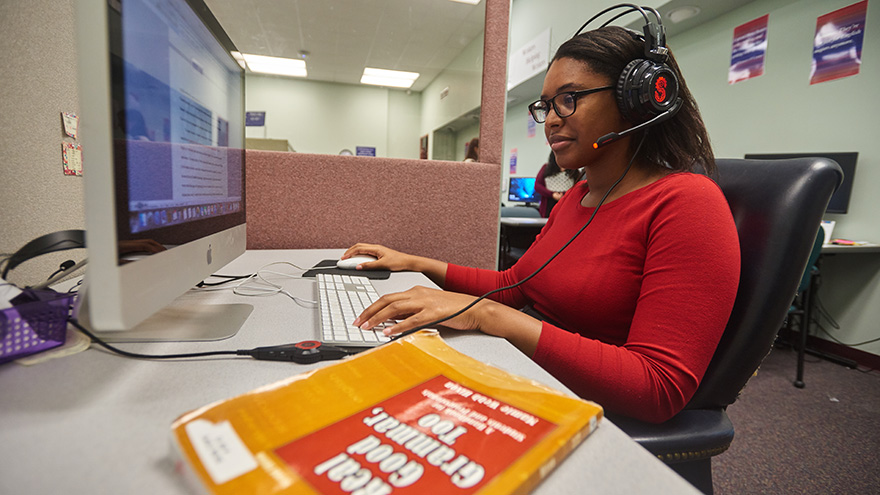
The Writing Lab has created an Internal webpage to better serve faculty requests.
Within the internal page, you will find links to the following services:
To access the internal webpage, log on to Argus and search for:
The “Directory (Services)” tab:
Paper Reading Information for Your Syllabus
The Writing Lab staff and I hope that you will encourage your comp students and other students to use the Lab’s paper reading services and thus help in training prospective graduate assistants, English teachers, and editors to assess others’ writing skills. Most of you tell your students that writing is a process and that good writing needs to be proofread and edited. Let the Writing Lab’s Paper Reading Staff be a part of that process.
If you are planning to inform your students of our paper reading service, below is some information for your syllabus or an addendum to your syllabus.
PAPER READING EXPECTATION
During the one-hour session, the Writing Lab expects the paper reader to engage in dialogue with the student about requested features of the student’s paper, including but not limited to content, grammar and mechanics, documentation style, and manuscript format. It is expected that using a question-and-answer, brainstorming technique, the reader will elicit input from the student in order to offer suggestions regarding clarity, development of ideas, correctness of expression, sentence form, organization, language, style, citing sources, etc.
SYLLABUS INFORMATION
Some information (written from your first-person point of view) to include in your syllabus regarding required paper readings:
Lab Work Options
UWF WRITING LAB
DIAGNOSTIC TESTING AND WRITING LAB WORK OPTIONS
The Writing Lab will have three options for instructors who want their students to do Lab Work. Please select the option that best meets the needs of your class. Each option – with or without diagnostic testing – requires Lab Work. Lab Work requires students to attend one-hour Skill-of-the-Week tutoring sessions in the Writing Lab. These tutoring sessions are by appointment only and are offered every hour on the hour from 10:00 a.m. to 5:00 p.m. daily, with the last appointment being at 4:00 p.m. Whichever option you choose, your students must ensure that they complete the required or requested skill during the week it is offered as the Skill-of-the-Week. The Skill-of-the-Week tutoring sessions begin Week 3 of each semester and run for 10 consecutive weeks through the end of Week 12, focusing on a different skill each week. Two skills are covered during some weeks. No tutoring is available during the last three weeks of each semester.
The Lab will no longer offer make-up lessons for missed skills/lessons.
When one of your students misses a weekly skills lesson, an “Incomplete” will be recorded on his or her Lab Work form. Since we will not have staff available to provide make-up lessons, we request that you not send notes by students with extenuating circumstances such as absence from class because of an extended illness. Instead, we recommend that you, as the instructor, waive the Lab Work requirement for the specific lesson(s) the student missed during his or her absence.
OPTION ONE – DIAGNOSTIC TEST ADMINISTRATION AND FOLLOW-UP LAB WORK
THE WRITING LAB'S DIAGNOSTIC TEST
During the first two weeks of the semester, a member of the Writing Lab staff will come to your classroom and administer the Writing Lab’s Diagnostic Test, a 70-item multiple-choice test that measures students’ knowledge of standard written American English. The Lab will score the tests, and a lab assistant will return the test scores to your class at the next scheduled class meeting. During this second visit, the lab assistant will also explain the Lab Work forms, the deadline policies, and other Lab services.
All students will receive an inventory of errors sheet with specific skills checked. You may require Lab work (a series of tests) based on the areas/skills checked on the Writing Lab's Recommendation Sheet.
We would appreciate your submitting an electronic request (see below) for diagnostic testing so that a complete packet can be prepared for you. If you want the test administered to more than one class, you will need to indicate this information on the form.
The Writing Lab has created an internal webpage to better serve faculty requests.
To access the internal webpage, log on to Argus <http://argus.uwf.edu> and search for the “Directory (Services)” tab:
On the Services sub-tab under “Writing Lab,” you will find the link to the Diagnostic Test Administration Request Form.
Beginning Week 3, your students will then do follow-up Lab Work by attending the Skill-of-the-Week tutoring sessions according to the tutoring schedule.
OPTION TWO – NO DIAGNOSTIC TEST ADMINISTRATION, SKILL-SPECIFIC LAB WORK
This option is for Lab Work that does not require administration of the Writing Lab’s Diagnostic Test.
You, as the instructor, should select all fourteen of the Writing Lab’s skills or seven or so of the Writing Lab’s 14 skills for your students to do in the Lab in order for them to receive credit for required Lab Work or to receive bonus points and extra credit.
The 14 skills are as follows:
Commas – use of commas for clarity, purpose, and effect
Semicolons and Colons – use of semicolons to separate sentences and to separate items in a series; use of colons to precede lists, quotations, and explanations
Sentence Errors (Fragments, Run-ons, and Comma Splices) – recognition of incomplete thoughts, two sentences with no punctuation separating them, and two sentences with only a comma separating them
Subject-Verb Agreement – grammatical use of singular subjects with singular verb forms ending in –s and plural subjects with plural verb forms ending in –s
Pronoun Reference and Pronoun-Antecedent Agreement – use of pronouns to substitute for a specific noun or pronoun, not an idea or entire sentence; grammatical use of pronouns with antecedents that agree in number and gender
Pronoun Case – grammatical use of pronouns depending on their function in the sentence
Diction – correct use of words that are commonly misused and confused such as affect and effect, advice and advise, lead and led, and principle and principal
Possessives – use of the apostrophe with singular and plural possessive words and with letters, numbers, and words used as words
Dangling and Misplaced Modifiers – correct placement of modifying elements and correct wording of sentences with opening participles
Verb Forms and Tenses – correct use of the principal parts of verbs, especially the past participle form (has done, has gone, has written, has seen, etc.); correct use of historical past tense, literary present tense, and other troublesome tenses
Faulty Comparisons – identification of illogical, double, and incomplete comparisons; use of the comparative and superlative degrees of adjectives and adverbs
Parallelism – correct use of conjunctions to connect structurally similar items in a series
Adjective and Adverb Use – correct use of adjectives such as good and bad with linking verbs; correct use of adverbs with other kinds of verbs
Capitalization, Hyphenation, Italicization, and Quotation Technique – use of capital letters with specific people, places, dates, courses; professional titles and departments; trademarks; etc.; use of hyphens; use of italics for long titles and quotation marks for short titles, dialogue, and other quoted material
The eight skills that research indicates are most troublesome for college students are as follows: Commas, Diction, Subject-Verb Agreement, Pronoun Reference and Agreement, Dangling Modifiers, Possessives, Pronoun Case, and Sentence Errors.
To take advantage of this option, use the attached form to indicate the skills lessons that you want your students to do and the date (during the first two weeks of the term) you want a lab assistant to come to your classroom and discuss the kind of Lab Work option you are requiring. During this visit, the lab assistant will have your students complete the student identification information on the Lab Work forms, explain the deadline policies, and review other Lab services. Since your students will not be taking the Lab’s Diagnostic Test, the lab assistant could come to your classroom on the first day of classes if you prefer.
Beginning Week 3, your students will then do the required follow-up Lab Work by attending the Skill-of-the-Week tutoring sessions according to the attached schedule. These tutoring sessions are by appointment only and are offered every hour on the hour from 10:00 a.m. to 5:00 p.m. daily, with the last appointment being at 4:00 p.m.
OPTION THREE – LAB WORK FOR EXTRA CREDIT
You may send your students to the Lab to do required Lab Work or extra credit Lab Work on an as-needed basis. To take advantage of this option, use the attached form to indicate the date (during the first two weeks of the term) you want a lab assistant to come to your classroom and discuss the kind of Lab Work option you are requiring. During this visit, the lab assistant will have your students complete the student identification information on the Lab Work forms, explain the deadline policies, and review other Lab services. Since your students will not be taking the Lab’s Diagnostic Test, the lab assistant could come to your classroom on the first day of classes if you prefer. This option should be taken before Week 3 since the Lab’s Skill-of-the-Week tutoring lessons begin the first Monday of week three.
Beginning Week 3, your students will then do the required follow-up Lab Work by attending the Skill-of-the-Week tutoring sessions according to the attached schedule. These tutoring sessions are by appointment only and are offered every hour on the hour from 10:00 a.m. to 5:00 p.m. daily, with the last appointment being at 4:00 p.m. Remember, though this is an extra-credit option, your students must complete each skill during the week it is offered.
LAB WORK SKILLS
Options Two and Three
YOU SELECT THE SKILLS YOU WANT YOUR STUDENTS TO WORK ON: Please check the skills you will be requiring your students to work on in the Writing Lab. Choose as many as you like.
Week 3
____Commas
____Semicolons and Colons
Week 4
____Sentence Errors: Fragments, Run-ons, And Comma Splices
Week 5
____Subject –Verb Agreement
Week 6
____Pronoun Reference & Agreement
Week 7
____Pronoun Case
Week 8
____Diction
Week 9
____Possessives/Apostrophes
Week 10
____Dangling and Misplaced Modifiers
____Verb Forms and Tenses
Week 11
____Faulty Comparisons
____Parallelism
Week 12
____Adjective and Adverbs
____Capitalization, Hyphenation, Italicization, and Quotation Technique
Please choose a date during Week 1 or Week 2 of the semester: I want the lab assistant to come to my classroom on (day of the week) ________________,
Day
______________________.
Date (Month and date)
Instructor ______________________ Building/Room Number _________
SUGGESTIONS FOR FACULTY
Consider giving your students 5 extra points for participating in an interactive paper reading session in the Writing Lab. I have found these points to be an encouraging way of compensating for any of the paper reader’s unfortunate oversights that result in the student’s losing points on his or her paper.
MOST REQUESTED PAPER READINGS
Final Draft: One-hour session for ungraded, finished papers. A paper reader will review all components of the student’s paper: manuscript format, content, documentation style, and correctness of expression.
Dual Conference: For ungraded, finished papers. Two separate appointments, two separate days. One hour for content, one hour for mechanics and grammar. A paper reader will review the student’s content in the first session; the same or a different paper reader will review grammar and mechanics in the second reading.
Grammar Check: One-hour session for review of grammar, punctuation, capitalization, word usage, spelling, and sentence construction only. A paper reader will help the student locate errors in his or her paper.
Paper Tutoring: Thirty-minute to one-hour session (depending on the paper’s length) for graded papers only. Walk-ins only – no appointment necessary. A paper reader will explain the student’s highlighted/marked errors and recommend appropriate revisions.
UWF WRITING LAB
Building 51, Room 157
We don’t write your students’ papers for them; we help them to write their papers better.
www.uwf.edu/writelab
Paper Reading Appointments: 474-2229
Grammar Hotline: 474-2129
Email: writelab@uwf.edu
YOU’VE GOT PROBLEMS? WE’VE GOT SOLUTIONS.
PROBLEM
Some of your students are submitting papers that are either unedited or poorly edited.
These students can walk in or make a one-hour appointment for an interactive Grammar Check Paper Reading.
PROBLEM
Some of your students are submitting papers that are poorly written, unorganized, and unedited.
These students can walk in or make an appointment for a one-hour, interactive Final Draft Paper Reading.
PROBLEM
Some of your students are submitting papers using their own documentation format instead of the required APA, MLA, AP, APSA, or Turabian style.
These students can walk in or make a one-hour appointment for an interactive Documentation Check Paper Reading.
PROBLEM
You have noticed a common problem in your students’ written work: use of it’s for its, for instance.
A Writing Lab assistant will come to your classroom and give a fifteen-minute Write @Vice lesson on using it’s and its. Just go to our website, choose the “Faculty” link on the left side of the homepage, and complete the form under the Write @Vice Classroom Lesson option. Notice that you can select any subject from our 101 Grammar Mini-lessons Series.
PROBLEM
Most of your students need a review of APA, MLA, AP, APSA, or Turabian documentation format.
A Writing Lab assistant will come to your classroom and give a fifteen-minute presentation on one of the following: APA style/format, parenthetical documentation, the reference list, or citing online sources. Just go to our website, choose Lab Services, and complete the form under the Presentation Request Form option.
OR Tell your students to pick up a handout in the Writing Lab or download it (as well as others) from the Lab’s Webpage.
Some of your students are losing points on their graded papers because of errors in punctuation, capitalization, word usage, sentence construction, spelling, and grammar.
Send these students to the Writing Lab for a walk-in Paper Tutoring, a session in which a paper reader will explain the marked errors and suggest corrections. You can then give your students POINTS RETRIEVABLE (all or some of the points lost) for having participated in the interactive Paper Tutoring session. A Paper Tutoring session is for graded papers only.
PROBLEM
Your specialization is law or computer science or management; so, although you recognize the errors in a student’s sentence like the one below, you don’t know what to label them:
Small business car insurance policies offer a number of coverage options that caters to the needs of both business owners and their employees, each of these options are explained in the enclose brochure, that is available to whomever requests them.
Call the Writing Lab’s Grammar Hotline, and one of our Hotline operators will research the information for you and give you a response.
OR Just circle the errors and send the student to the Writing Lab for a walk-in Paper Tutoring (the paper reader will explain the errors).
PROBLEM
You have a student whose written work does not meet your or the department’s expectation of “academic and grammatical literacy” because it contains constructions such as “to” for “too,” “than” for “then,” “sit” for “set,” “their” for “they’re,” “you’re” for “you’ll” or “your,” etc.
Since the errors named above are prohibiting your student from producing college-level papers relatively free of language errors, he or she may need one-to-one assistance in weekly independent study sessions with a specific Writing Lab consultant.
PROBLEM
Some of your students do not realize what they should review in order to upgrade the quality of their written work.
Use the Writing Lab post-it to check off areas that are affecting the student’s ability to communicate in standard edited English.
Many of your students say, “I think I write really good and know grammar real well.”
Let a member of the Writing Lab staff come to your classroom to administer a diagnostic test of standard written English skills. Your students may find the results of this test helpful in assessing their ability to recognize sentences that contain language and punctuation errors.
Many of your students need a review of basic grammar.
Students can read the online Grammar Reviews on the Writing Lab’s website. The Writing Lab delivers Write @Vice Skill-of-the-Week presentations, with follow-up worksheets on the skill, every hour on the hour in the Writing Lab. These interactive sessions utilize a 20-20-20 format. The first 20 minutes, a qualified tutor reviews the skill; the second 20 minutes, the students take a lesson on the skill; and the last 20 minutes is interactive, and the students are called on to answer questions from the lesson. These sessions are by appointment only.
Your students need information on writing a proposal, a business letter, or an abstract.
Tell your students to pick up a handout from the Lab or download any or all of our informational handouts from the Lab’s Webpage.