


Dr. M. Lal Goel
Emeritus Professor of Political Science
M. Lal Goel
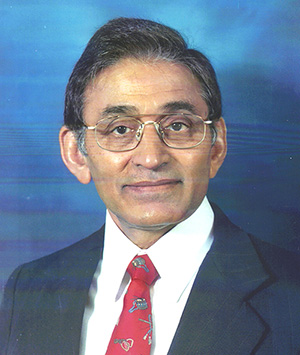
Also known as Dr. Madan Lal Goel
- Position: Emeritus Professor of Political Science
- Department: Reubin O'D. Askew Department of Government
- Contact: lgoel@uwf.edu
- Curriculum Vitae
Biography
Dr. M. Lal Goel (also known as Dr. Madan Lal Goel) is an Emeritus Professor of Political Science at the University of West Florida. Dr. Goel served as the Director of International Studies in the Department of Government. He retired several years ago, but has stayed active at the University. He served as the President of the UWF Retired Employees Association. He continues to lecture at public forums on topics of national and international importance.
His Life Story may be read in Two Parts at:
India to America -- An Asian Journey Part 1
India to America - An Asian Journey Part II
Academic Degrees
- Ph.D. Political Science, State University of New York at Buffalo, 1969.
- M.A. Journalism and International Relations, University of Oregon, 1959.
- B.A. Liberal Arts (Honors), Ranbir College, Punjab University, 1956.
Academic/Professional Experience
- Professor of Political Science, University of West Florida, 1978—2003
- Director of International Studies, University of West Florida, 1980--2003
- Associate Professor, University of West Florida, 1972-78.
- Assistant Professor, University of West Florida, 1969-1972.
- Instructor and then Assistant Professor, Niagara University, N.Y., 1966-1969.
- State University of New York, Buffalo, Instructor & Teaching Assistant, 1963-66
Articles on the Web
A few articles also online at intellectualshatriya.com.
Articles
- A New Earth in the Making
- On Human Unity
- Clash of Civilizations and Radical Islam
- God is not One—Religions are Different
- God is not One -- Differences Matter
- Myth of Aryan Invasions of India -- In Brief
- God Against the Gods -- Monotheism V. Polytheism
- Asian Americans - A Model Minority
- Professor Wendy Doniger: A Dhimmi
- Coward Hindus or Failed Islam in India
- Evolution of Consciousness in 21st Century
- Hinduism -- Its Essential Features in Brief
- If God is our Father, Why not our Mother?
- India in the West -- the New Thought Movement
- Indians in America -- Doing Great
- India's Caste System and American Pluralism -- Some Similarities
- Democracy in India -- Its Foundation in Cultural Pluralism
- Japanese Culture and Politics - Some Observations
- Indo-American Relations in a New Light
- God of Small Things by Arundhati Roy -- A Review
- Sri Aurobindo -- A Brief Sketch
- A Presidential System for India: conversation with Aditi Banerjee, Sept 2020
- India to America -- An Asian Journey Part 1
- India to America -- An Asian Journey Part 2
- “ Who are the Jews of India ,” Congregation Keneseth Israel, Allentown, PA, May 20, 2018
- " Who are the Jews of China and Japan?"
Books Published
Social and Political Science Research Methods, Delhi: Ajanta International Publishers, 1997, 307 pages. Coauthored with Dr. V. B. Singh.
Political Science Research: A Methods Handbook, Ames: Iowa State University Press, 1988, 310 pages.
Political Science Research: A Methods Workbook, Ames: Iowa State University Press, 1988, 194 pages.
Political Participation: How and Why Do People Get Involved in Politics?, Chicago: Rand-McNally, 1977, (2nd edition), 223 pages (Reviewed in American Political Science Review, 1978, p. 1482). Co-authored with Dr. Lester Milbrath.
Political Participation in a Developing Nation: India, New York: Asia Publishing House, 1975, 234 pages.
(Reviewed in Journal of Asian Studies, 1977, p. 769).
Honors and Awards
National Science Foundation Award for College Teachers, University of Colorado, Summer 1970.
Recipient of the Distinguished Research and Creative Activities Award, The University of West Florida, 1979. Only one faculty member is chosen yearly for this honor at the University.
Recipient of the Distinguished Teaching Award, University of West Florida Student Government, 1996. One faculty member is chosen from the College.
Recipient of the Teaching Excellence Award (the TIP Award), 1997.
This Award was established by the Florida Legislature to recognize outstanding teachers in the State.
Recipient of the University’s “Excellence in Undergraduate Teaching and Advising Award,” 1997. Selection for this Award is made by a University-wide faculty committee.
Recipient of the University’s PEP (Professorial Excellence Program) Award, 1998. This award was established by the Florida Legislature to recognize outstanding faculty in the State for their contributions in the three areas of Research, Teaching and Service.
Golden Apple Award, Foundation for Excellence in Education, Florida, 1998.
Recipient of the Fulbright Scholar Award, 1998.
Courses Taught
- Comparative Government and Politics
Research Methods in Political Science
Conflict, Violence and Peace
Culture and Politics of India and South Asia
Politics of Developing Nations
Legislative Process
Introduction to Political Science - Graduate Seminar in Comparative Politics
Public Speeches
I am an active community-level speaker on topics of national and international interest.
- “India’s Democracy on Trial,” WAVES Conference, Delhi, Dec 5, 2019
- “Radicalism and Terrorism in the US and the World,” Pensacola, Fl Aug 30, 2019
- “Jews of Asia,” Congregation Keneseth Israel, Allentown, PA, June 9, 2019
- “Trump and the Immigration Debate,” Leisure Learning Society at UWF, September 14, 2018.
- “,” Congregation Keneseth Israel, Allentown, PA, May 20, 2018
- “DIWALI: The Hindu Festival of Lights,” Spring Hill College, AL, Nov 2, 2017
- “Radicalism and Terrorism,” World Affairs Roundtable, AL, Oct 4 & 11, 2017
- “Death of Europe—Its Demographic Crisis,” Univ West Fl, Oct 13, 2017
- “Emerson, Thoreau & Walden Pond,” Unitarian Universalist Church, 3 Sept, 2017
- “The Perennial Tradition in World Religions,” Fairhope Unitarian Fellowship, 15 May 2016
- “Celebrating Interreligious Friendship,” Center for Interreligious Understanding, Spring Hill College, AL, 19 April 2016
- “Diwali: the Festival of Lights,” Pensacola Unitarians, 15 Nov 2015
- “Evolution--Big Bang to the 21st Century,” Unitarian Univ. Church, 24 May 2015
- “Whither Goes America?” Fl Leisure Learning Society, 10 April 2015
- “Rise of Yoga and Bhakti in the United States,” WAVES, Delhi, 17 Jan 2015
- “The Importance of One’s Mother Tongue”, Punjab Gobindgarh College, 7 Mar 15
- “NRI’s in the U.S.,” Pondicherry University, 12 March 2015
- “Whither Goes India?” Fl Leisure Learning Society, 26 September 2014
- “Whither Goes the Middle East,” Fl Leisure Learning Society, 19 Sept 2014
- “ Who are the Jews of India ?” Jewish Temple Beth-El, Pensacola, Fl , 10 Jan 2014
- Who are the Jews of China and Japan
- “A New Earth in the Making,” Pensacola Church, 9 June 2013
- “Interfaith Dialogue” Hosted by Faith in Action, Florida, 4 April, 2013
- “India Rising,” World Affairs Council, Fairhope, Al, 2, 9 Oct 2013
- “The Spiritual Meaning of ‘Avatar”, Fort Walton Beach , Fl 2011
- “Challenges to American Power,” Forum: Lehigh Valley Unitarian Universalist Church, PA, 20 June 2010
- “Asian Americans—Who and What?” Featured Speaker, U.S. Naval Station, the Asian and Pacific Islander Heritage Month, Whiting Field, Florida, 27 May 2010
- “War: Lessons from History,” Leisure Learning Society, 8 June 2010
- Can American Power Survive in the 21st C? Gulf Coast Economics Club, 19 May 2010