


Reubin O'D. Askew Department of Government
The Reubin O'D. Askew Department of Government at UWF offers Bachelor of Arts degrees in Political Science, Political Science Pre-Law, and International Studies. The department offers Masters of Arts degrees in Political Science and International Affairs. Students may also minor in International Studies, Political Science, Political Science Pre-Law, and Spanish.
About the Program

Our students will gain an understanding of the problems that arise in the pursuit of the good life shared with others; study law, political institutions, and political leadership; learn to assess and compare the performance of regimes; and learn the problems of war, peace and contemporary political issues.
- Internships
- Pi Sigma Alpha, National Honor Society
- Model United Nations
- Moot Court Society
- American Foreign Policy
- Ancient Political Philosophy
- Constitutional Law
- Democracies
- Dictatorship
- The Founders’s Constitution
- Human Rights
- International Law
- Legislative Process
- Political Economy
- Congressional Aide
- Foreign Service Officer
- Intelligence Analyst
- Lawyer
- Legislator
- Lobbyist
- Policy Analyst
- Political Campaign Manager
- Political Consultant
- Teacher
- Think Tank Specialist
Upcoming Events
You will find information below on our upcoming events.
Past Events
Please find information and recordings of our past events below.
March 3, 2026 | Seligman Lecture
To Preserve the Freedom of the Human Mind: The First Amendment and the Pursuit of Happiness - Jay Cost
The University of West Florida’s Reubin O’D. Askew Department of Government hosted the 2026 Seligman First Amendment Lecture, featuring political theorist Dr. Jay Cost, on Tuesday, March 3, 2026, at the Museum of Commerce in downtown Pensacola.
Dr. Cost presented “To Preserve the Freedom of the Human Mind: The First Amendment and the Pursuit of Happiness.” The event examined the essential connection between intellectual freedom and the democratic ideals that shape American civic life.
This year’s lecture coincided with national preparations for the 250th anniversary of the United States, known as America250, which will be commemorated on July 4, 2026. This milestone marks 250 years since the signing of the Declaration of Independence. Across the country—and at the University of West Florida—2026 serves as a moment to reflect on the enduring principles of liberty, democracy, and civic engagement through scholarly discussion, historical reflection, and public dialogue.
Dr. Cost is the Gerald R. Ford nonresident senior fellow at the American Enterprise Institute (AEI), where he focuses on political theory, Congress, and elections. He also serves as a visiting scholar at Grove City College and a contributing editor at the Washington Examiner. His research centers on civic republicanism in the United States, with emphases on the political theory of James Madison, the problem of political corruption, the role of political parties, the development of civic institutions, and the power and responsibility of Congress.
You may access a recording of this event at the link below. A transcript is attached to the video.
April 9, 2026 | Askew Lecture
East Asia, the United States, and the Future of Democracy - Dr. Erik Mobrand
On April 9, 2026, the University of West Florida Askew Lecture Series returned to the Museum of Commerce with a timely discussion on “East Asia, the U.S., and the Future of Democracy.” The event featured Dr. Erik Mobrand, professor at the Graduate School of International Studies at Seoul National University and a leading scholar on South Korean politics.
Mobrand’s research focuses on South Korean politics, democratization, urban politics and resistance, authoritarian legality, and international science collaboration. He is the author of Top-Down Democracy in South Korea and earned his Ph.D. from Princeton University.
While popular movements in South Korea rightly grab the headlines for forcing political change and holding leaders to account, those movements are only part of the story of the construction and practice of democracy. In Top-Down Democracy in South Korea, Erik Mobrand documented another part – the elite-led design and management of electoral and party institutions. Even as the country left authoritarian rule behind, elites have responded to freer and fairer elections by entrenching rather than abandoning exclusionary practices and forms of party organization.
Exploring South Korea’s political development from 1945 through the end of dictatorship in the 1980s and into the twenty-first century, Mobrand challenged the view that the origins of the post-authoritarian political system lie in a series of popular movements that eventually undid repression. He argued that we should think about democratization not as the establishment of an entirely new system, but as the subtle blending of new formal rules with earlier authority structures, political institutions, and legitimizing norms.
*This installment of the Askew Lecture Series was sponsored by the Reubin O’D. Askew Department of Government, the John C. Pace Symposium Series, and the Askew Lecture Series.
**The Askew Lecture Series is a downtown community talk on current political issues and public policy topics. The lecture honors the legacy of the late Governor of Florida, Reubin O'D. Askew, the department’s namesake. Governor Askew was a champion of civic engagement known for tackling vital public policy issues of the day.
October 16, 2025 | American Foreign Policy Webinar
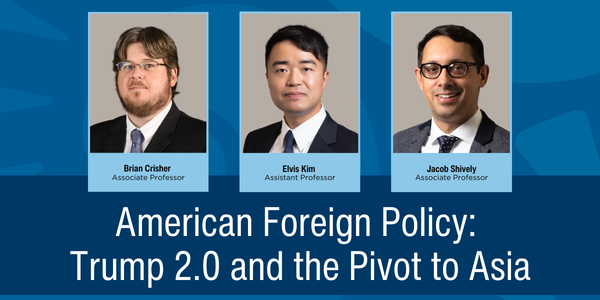
Trump 2.0 and the Pivot to Asia
On Thursday, October 16, 2025, the Reubin O’D. Askew Department of Government hosted a Zoom Webinar on the Trump administration’s foreign policy and its relations with allies and competitors across the Pacific. Faculty experts from the Reubin O’D. Askew Department of Government provided introductory remarks and then took questions from the audience.
Featured faculty included Dr. Brian Crisher, associate professor and specialist in international conflict and military capabilities; Dr. Elvis Kim, assistant professor with expertise in democratization, social movements, and East Asian politics; and Dr. Jacob Shively, associate dean of the College of Arts, Social Sciences, and Humanities and associate professor, whose scholarship focuses on U.S. grand strategy and cybersecurity policy. Dr. David Ramsey, department chair and professor, hosted the webinar and teaches constitutional law and political philosophy.
September 24, 2025 | Constitution Day
.png)
John Dickinson and the Creation of Independence
The Reubin O’D. Askew Department of Government hosted its annual Constitution Day lecture on September 24th in the UWF Conference Center Ballroom. This year’s event featured Dr. Jane E. Calvert, historian and founding director of The John Dickinson Writings Project.
Dr. Calvert spoke on the political thought of John Dickinson, one of the few American leaders to contribute to the Declaration of Independence, the Articles of Confederation, and the U.S. Constitution. Her award-winning biography, Penman of the Founding: A Biography of John Dickinson (Oxford, 2024), provides further insight into his life and legacy.
“As a department, we’ve expanded our community outreach with events like World Languages Movie Night, the Seligman and Askew Lectures, and the annual foreign policy webinar,” said Dr. David Ramsey, chair of the Askew Department of Government. “But Constitution Day remains our signature event, giving students and community members an opportunity to reflect on the enduring significance of the Constitution. This year, it was a real pleasure to watch our students engage Dr. Calvert with thoughtful questions and hear her respond in real time.
Dr. Calvert was interviewed by T.S. Strickland for WUWF ahead of the Constitution Day event. You may read or listen to the interview at this link.
Watch 2025 Constitution Day Lecture
March 27, 2025 | Askew Lecture
Debating American Grand Strategy in the Trump Era - Ionut Popescu and Jacob Shively
On March 27, 2025, the University of West Florida’s Askew Lecture Series welcomed more than 70 attendees from both campus and the broader Pensacola community to the Museum of Commerce for a timely and dynamic discussion on Debating American Grand Strategy in the Trump Era.
This year’s event featured Dr. Ionut Popescu, associate professor at Texas State University and U.S. Navy Intelligence officer, and Dr. Jacob Shively, associate professor of political science at UWF. Together, the two scholars explored how the return to a Trump presidency could reshape American foreign policy — raising urgent questions about global power dynamics, realism, and America's role on the world stage.
The evening opened with remarks from Dr. David Earle, Dean of the College of Arts, Social Sciences and Humanities, followed by a welcome and speaker introductions by Dr. David Ramsey, chair of the Reubin O'D. Askew Department of Government.
Drs. Shively and Popescu took the stage at dual podiums for a spirited exchange of perspectives. Dr. Shively examined themes of American internationalism, emphasizing military power, credible threats, trade integration, and the role of democracy versus autocracy. He argued that Trump’s likely approach would lean less on traditional realism and more toward hierarchical and nationalistic strategies — a neo-colonial model of foreign engagement that prioritizes domestic advantage over international cooperation.
Dr. Popescu presented a contrasting perspective grounded in realism, asserting that a more realist orientation would strengthen U.S. foreign policy. Drawing from his recent book No Peer Rivals, Popescu emphasized the importance of strategic focus on China as America's only true near-peer competitor. He argued that the United States should take deliberate steps to maintain its status as the dominant global power. Popescu also highlighted pressing concerns such as immigration, fentanyl trafficking, and the role of China in chemical precursor production, as well as economic perspectives on climate change — advocating for market-based solutions over regulatory measures.
The event concluded with a lively Q&A session and a book signing featuring both scholars’ latest works. Dr. Ionut Popescu signed copies of No Peer Rivals: American Grand Strategy in the Era of Great Power Competition (University of Michigan Press), while Dr. Jacob Shively signed copies of Make America First Again: Grand Strategy Analysis and the Trump Administration (Cambria Press).
This year’s Askew Lecture continued its tradition of fostering civic dialogue on urgent policy issues, honoring the legacy of Governor Reubin O’D. Askew and his commitment to thoughtful leadership and public service.
*This installment of the Experience UWF Downtown Lecture Series was sponsored by the College of Arts, Social Sciences and Humanities, the Reubin O’D. Askew Department of Government, the John C. Pace Symposium Series, the Askew Lecture Series, and the Panhandle Tiger Bay Club.
**The Askew Lecture Series is a downtown community talk on current political issues and public policy topics. The lecture honors the legacy of the late Governor of Florida, Reubin O’D. Askew, the department’s namesake. Governor Askew was a champion of civic engagement known for tackling vital public policy issues of the day.
February 20, 2025 | Seligman Lecture
Book Censorship: Then and Now - Robert Spoo
The 2025 Seligman First Amendment Lecture brought together students, faculty, and community members for a compelling discussion on the evolving challenges of book censorship and intellectual freedom. Held on February 20, 2025, at the Museum of Commerce, the event featured Dr. Robert Spoo, a distinguished scholar of intellectual property law and literary censorship.
During his lecture, "Book Censorship: Then and Now," Professor Spoo examined the historical parallels between early 20th-century book bans and today’s growing censorship efforts, highlighting the legal and societal impacts of restricting literary works. Drawing on his expertise in modernist literature and copyright law, Spoo provided critical insights into how censorship debates shape public discourse and creative expression.
Following the lecture, attendees participated in a Q&A session, engaging in a thought-provoking discussion on free speech, book bans, and the role of literature in society. The event underscored the importance of First Amendment protections and the ongoing need for open dialogue on these pressing issues.
*The Seligman First Amendment Lecture Series fosters dialogue on campus and in the community about the First Amendment freedoms of religion, speech, press and association. It is made possible by a generous gift from the Jane G. and Fred K. Seligman Endowment.
October 10, 2024 | Constitution Day Lecture
-200x200.jpg)
The Constitution and Freedom of Speech - Dr. Elizabeth Amato
Continuing the University of West Florida's 2024 Constitution Day events, the Reubin O’D. Askew Department of Government hosted Dr. Elizabeth Amato, Associate Professor of Political Science for the Department of Social Science at Gardner Webb University, on Thursday, October 10, 2024 to speak on “The Constitution and Freedom of Speech.”
All UWF faculty, staff, students and alumni were invited. This lecture was also open to the public.
Watch 2024 Constitution Day Lecture